Showing posts with label business energy. Show all posts

Thursday, 5 October 2017

Our cold calling campaign continues

Energy Advice Line renews calls for cold calling

The Energy Advice Line has spearheaded a campaign for the energy regulator Ofgem to ban the practice of cold calling because it placed undue pressure on consumers to agree to energy deals that were not necessarily the cheapest available.

"Although this case related to automated calls, it highlights the lengths that some companies go to to pressure consumers to buy their product or service," Mr Morgan said.

"We firmly believe that truly independent and reputable price comparison and switching services should not resort to unsolicited telephone calls. In awarding the record fine, the Information Commissioner rightly described nuisance calls as a 'modern pest'.

"Chooseing an energy supplier is a cruical decision because a bad choice can cost a household or business hundreds of pounds, or even more in the case of large organisations.

"Consumers need time to consider their decision and not be placed under pressure during an unsolicited telephone call."

Mr Morgan said he was aware of cases where consumers had been called, repeatedly, in once case while they were attending a funeral, by unscrupulous energy 'brokers' using heavy pressure sales techniques to force them to agree to an energy deal.

He said in many cases these cellars were not independent, despite their claims to the contrary, and were often calling on behalf of a single energy supplier and therefore not necessarily offering the cheapest deals.

"We would like Ofgem or the Information Commissioner to investigate the practice of cold calling by energy suppliers and the third parties they sometimes engage to do it," Mr Morgan said.

"Consumers need to take control of their energy supplies and shop around to find them the best deals, and switch accordingly.

"Truly independent and reputable services like the Energy Advice Line would never engage in cold calling because we don't need to. Consumers trust us to help them shop around and we never pressurise them to make a decision.

"Unfortunately not all suppliers or price comparison services take the same view and consumers need to be protected from them."

The Energy Advice Line is one of the UK's leading price comparison and switching services for business and domestic energy customers. It is also an advocate for energy market reform and has campaigned for a better deal for energy users, including calling for a ban on cold calling and changes to regulations to make it easier for all consumers to switch suppliers.

The service is completely independent and free. Consumers can quickly and simply search the market for the best available energy deals from an extensive panel of small and large energy suppliers. The service also offers a free advice line for business energy customers.

For further information visit energyadviceline.org.uk

Thursday, 21 September 2017

Are you ready for winter energy bills?

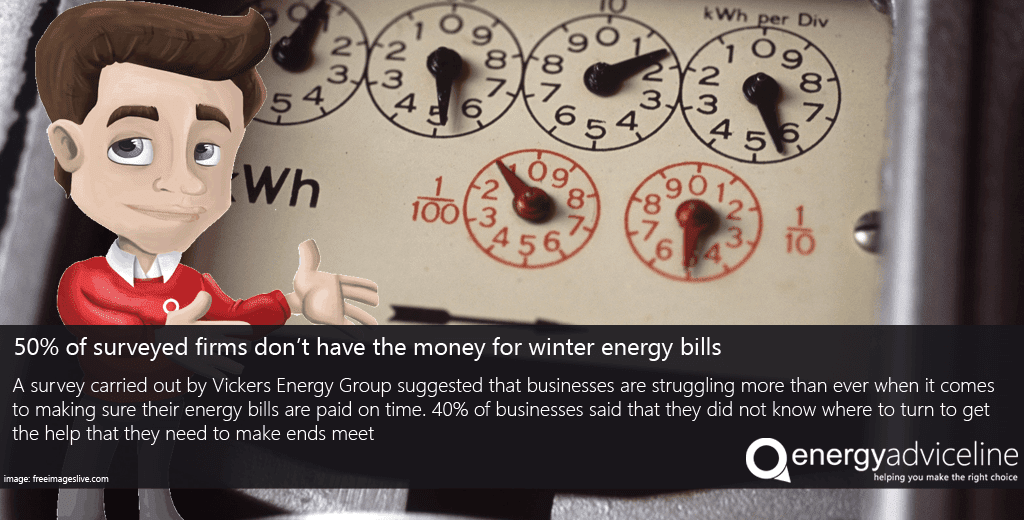
50 per cent of surveyed firms can't pay energy bills

More small and medium-sized firms should seek help with reducing their energy bills says The Energy Advice Line.

Julian Morgan, managing director of the price comparison, switching and advice service for energy users, said a new survey by Vickers Energy Group suggested firms were not taking control of their gas and electricity supplies.

"It's crucial for SMEs not to put their energy supplies in the too hard basket and just coast along hoping for the best," Mr Morgan said.

"Just because the lights are on and the printer is working, doesn't mean that your business electricity bills are sorted. When prices are high and volatile as they are at the moment, it's important to take charge to avoid paying much more than you need to."

According to the survey, almost 50% of firms said they didn't have "readily available" funds to pay for their energy bills and 75% said they were familiar with "bill shock" during energy intensive cold winter months.

Further, the survey found that 40% of SMEs had never been offered any help or advice on how to reduce their expenditure on energy.

Mr Morgan said more firms needed to pick up the phone and discuss their energy bills with an independent and reputable energy service like the Energy Advice Line.

"We have expert advisers who know all there is to know about energy bills and switching," Mr Morgan said. "Being on the right tariff is key and good advice is essential.

"Taking out a fixed term contract, for example, can significantly reduce the prospoext of "bill shock", which comes from not really knowing what you are paying for your energy.

"This security of knowing that your tariff will not increase over a certain period makes it much easier for a firm to budget for their energy bills and to reduce the risk of not having the money to pay a bill when it arrives.

"We can also advise on other ways to keep bills under control, like paying by direct debit.

"But most of all we can help firms find the cheapest available deals for the needs, and facilitate the switch so that it's seamless and easy. To do otherwise is to throw money away."

The Energy Advice Line is a consumer champion and an independent price comparison and switching service for householders and small and medium-sized businesses. The service enables consumers to quickly and simply compare electricity and gas prices, and to switch to the best available deal on the market.

The service also offers free advice and a contract management service, including alerts to remind business consumers when their fixed-term energy contracts are about to end.

For further information, visit energyadviceline.org.uk

Thursday, 24 August 2017

Only 1/5 business shop around for energy

81% of SMEs don't shop around for energy

Most small and medium-sized firms were missing out on savings by failing to shop around for their energy supplies.

Julian Morgan, managing director of the price comparison, switching and advice service for energy users, said he was shocked by the findings of the survey by independent supplier Opus Energy.

The survey found that 81% of small businesses failed to shop around for their energy supplies, while almost one-quarter were paying out-of-contract rates for their gas and electricity.

Significantly, 12% of businesses had never switched suppliers, opting to stay loyal to their existing energy company.

“It’s very clear, and actually quite shocking, to see that so many time-pressed small business owners and decision makers are simply not prioritizing their energy supplies,” Mr Morgan said.

“There’s no doubt that most of these firms are paying more than they need to by not switching – and depending on the size of the company and the sector they are in – this could amount to hundreds of pounds in lost savings each year.

“Those companies that have never switched suppliers have lost out the most, probably by a significant amount.”

Mr Morgan said many SME owners wrongly believed it was not worth their while to switch suppliers, and that it would be a long and complicated process to shop around.

“Nothing could be further from the truth, “ Mr Morgan said. “Using a reliable and reputable switching service like the Energy Advice line means business owners save themselves all the legwork. 
“And once we find them a cheaper deal, we handle the switching and provide a free contract management service as well. There’s no obligation and the service is free.”
Mr Morgan particularly appealed to small firms that had never switched suppliers, and those who were on expensive out-of-contract rates to shop around for good fixed-rate deals.
In other areas, the Opus Business Boost Report showed that the majority of UK SMEs were trying to manage their energy better and had adopted a positive attitude towards renewable supplies. 
Of the 500 SMEs surveyed, 78% said they were keen to be supplied with renewable energy and of these, 40% wanted it because of its smaller environmental impact and 38% to advance their green credentials. 
More than half (51%) of businesses already have smart meters to help them keep track of their energy use, although a fifth didn’t know how to use their meter.
The Energy Advice Line is one of the UK's leading price comparison and switching services for business and domestic energy customers. It is also an advocate for energy market reform and has campaigned for a better deal for energy users, including calling for a ban on cold calling and changes to regulations to make it easier for all consumers to switch suppliers.
The service is completely independent and free. Consumers can quickly and simply search the market for the best available energy deals from an extensive panel of small and large energy suppliers. The service also offers a free advice service for business energy customers throughout the to of their energy contracts.
For further information visit www.energyadviceline.org.uk

Thursday, 22 June 2017

Restaurants - take control!


Britain's catering sector should take control of energy costs by cutting waste and shopping around for better deals to recude it's £1.3 billion annual spend on energy, according to Energy Advice Line.

A survey of 150 restaurant owners, managers and chefs carried out by Big Six energy supplier E.ON showed energy worries came second only to staff issues, yet three-quarters admitted they didn't know how to reduce their energy consumption.

The research revealed that despite more than 80% of restaurateurs saying they considered sustainability when making business decisions, 75% said they do not have the tools and knowledge to make changes. Energy costs make up almost a quarter of overheads for the restaurant and catering industry, with an estimated 10% of this lost on wastage.

"The findings must be a major concern for the catering industry, which is one of the most energy-intensive sectors in the UK," said Julian Morgan, managing director of the Energy Advice Line, the UK's leading price comparison and switching service for consumers.

"It's estimated that reducing energy use by 25% across the industry could result in savings of £325 million - a significant amount for a sector where margins are often very tight.

"We urge small and large organisations in this sector to really take control of their energy costs - by implementing a workplace energy saving plan, and by shopping aorund for the very best energy deals.

"We understand that energy bills often languish in the too hard basket in the hospitality sector, but in reality this is the industry that can least afford to do that."

The survey revealed that the profit margin of an average UK restaurant was approximately 8%. With estimated energy savings of nearly 25% achievable in most restaurants, the research showed they could boost profit margins to around 12.6%.

Chefs and retaurateurs admitted to leaving on gas hobs, grills, deep fryers, heat lamps and ovens throughout service so that high quality food could be turned out quickly. The Carbon Trust estimates that the UK hopsitality sector generates the equivalent of about 8 million tonnes of carbon - greater than the entire carbon emissions of Costa Rica or Kosovo.

Michelin-starred chef Glynn Purnell and E.ON have launched a campaign to help small businesses save energy and money through a special Energy Toolkit created to help firms manage their energy use and plan efficiencies.

"Restaurants need to strike a balance between quality food and service and energy costs, for the sake of their bottom line and the environment," Mr Morgan said.

"It sounds hard but it's not - restaurateurs need to devise an energy saving strategy and get their staff to embrace the policy. There is a range of things they can do to save money - choosing energy-saving equipment, locating fridges and freezers away from hot kitchens, and considering induction hobs instead of gas just to name a few.

"But switching suppliers is the easiest way of all to cut costs. Restaurateurs are simply wasting large amount of money if they don't check the market for the best deals and switching suppliers accordingly."

The Energy Advice Line is a consumer champion and an independent price comparison and switching service for householders and small and medium-sized businesses. The service enables consumers to quickly and simple compare electricity and gas prices, and to switch to the best available deal on the market.

The service also offers free advice and a contract management service, including alerts to remind business consumer users when their fixed-term energy contracts are about to end.

For further information, visit energyadviceline.org.uk

Thursday, 9 March 2017

Are business energy bills a worry?

50% of surveyed firms can't pay energy bills

More small and medium-sized firms should seek help with reducing their energy bills says The Energy Advice Line.

Julian Morgan, managing director of the price comparison, switching and advice service for energy users, said a new survey by Vickers Energy Group suggested firms were not taking control of their gas and electricity supplies.

"It's crucial for SMEs not to put their energy supplies in the too hard basket and just coast along hoping for the best," Mr Morgan said.

Thursday, 16 February 2017

Don't put off relocation

Seek help when relocating your business

The Energy Advice Line has urged small businesses that need to move premises to get in touch after a survey showed 20% of firms put off relocating because they cannot face changing service providers.

Julian Morgan, managing director of the price comparison, switching and advice service for energy users said it was unfortunate that so many business owners were staying in potentially inappropriate premises because dealing with suppliers was so hard.

“Small business owners should get in touch with us because we can sort out their business energy needs, leaving them free to get on with moving and ensuring their firms make a smooth transition to new premises,” Mr Morgan said.

Thursday, 10 November 2016

Millions of consumers on 'energy autopilot'

Millions of consumers on 'energy autopilot'

Millions of businesses and households were missing out on substantial savings on their energy bills because they assumed they were on the cheapest tariff without actually checking, according to the Energy Advice Line.

Julian Morgan, managing director of the price comparison, switching and advice service for energy users, said a new survey by the Energy Saving Trust showed the extent to which UK consumers were unaware they were paying too much.

The survey found thatm ore than 13 million British households missed out on savings last year because they didn't switch suppliers. It also revealed that a large number of consumers were on 'energy autopilot', with nearly 60% of non-switchers believing they were on the cheapest tariff available, which the Trust said was unlikely.

"This is further evidence that many businesses and households are missing out on substantial savings on their energy bills because they wrongly assume they are on the cheapest tariff," Mr Morgan said.

"The truth is that energy prices are always fluctuating and suppliers are constantly changing their fixed and non-fixed deals.

"This means that no-one can assume they are on the cheapest tariffs without shopping around on a regular basis, and switching supplier accordingly."

Recent figures from the enegry regulator Ofgem show that households can save around £300 each year just by switching suppliers, yet the majority of consumers fail to do this.

In fact, the Energy Saving Trust survey showed that consumers were more than twice as likely to change home insurer than energy provider, with only 24% oh households having switched at least four times in the past decade.

"These figures should really trigger alarm bells with Ofgem and the government, and prompt them to do more to encourage consumers to shop around and switch," Mr Morgan said.

"Bill and tariffs are still too complex for consumers to be able to compare deals easily, so more needs to be done to make it as simple to switch their energy supplier and their insurer.

"The government also needs to drive home the message that the savings to be made from switching supplier regularly really are substantial.

"Mostp eople wouldn't contemplate throwing £300 down the drain - yet this is what they could be doing by not being pro-active when it comes to their energy supplies."

The Energy Advice Line is one of the UK's leading price comparison and switching services for business and domestic energy customers. It is also an advocate for energy market reform and has campaigned for a better deal for energy users, including calling for a ban on cold calling and changes to regulations to make it easier for all consumers to switch suppliers.

The service is completely independent and free. Consumers can quickly and simply search the market for the best available energy deals from an extensive panel of small and large energy suppliers. The service also offers a free advice line for business energy customers.

For further information visit energyadviceline.org.uk

Thursday, 3 November 2016

Consumers should brace for price hikes

Consumers should brace for price hikes

Consumers should ensure they shop around for the best energy deals now, following warnings by experts that the weaker pound is pushing up the cost of imported gas and electricity, according to the Energy Advice Line.

Julian Morgan, managing director of the price comparison, switching and advice service for energy users, said one supplier had already announced a 30% hike for around 70,000 of its customers.

GB Energy Supply, a new supplier that entered the market in January last year, recently announced it would increase average annual bills from £820 to £1,060 for customers on its standard variable deal. In August, OVO Energy announced a 3.6% increase and Co-operative Energy put up prices by 3% in October.

Industry analysts have predicted that other suppliers will follow suit. Samuel Tombs, chief UK economist at Pentheon Macroeconomics, was reported last week as saying that bills could go up by 5% in the short term and 15% over a longer period. This was in response to the wholesale costs for gas and electricity jumping by 20% and 50% respectively since the summer.

"It's now time to act without delay," Mr Morgan said. "Consumers need to shop around to get the best deals.

"The trend is upward for energy prices and consumers need to be pro-active to protect themselves from nasty surprises as the cold weather sets in.

"It's widely expected that the Big Six suppliers will raise their prices this winter, with potentially further price hikes to come down the track."

Mr Morgan said that consumers should shop around and consider locking themselves into fixed deals while they were still available. Although prices were generally on the rise, there were still very good competitive deals available.

"The potential savings to be made through switching are significant, particularly if you have never switched before, or haven't done so for a while," Mr Morgan said.

"Ofgem estimates consumers can save £300 annually but it very much depends on how often you switch.

"For those consumers on a standard energy tariff - by far the most expensive - the savings to be achieved by switching could be even more than £300 annually.

"And even for the very small minority of customers who switch suppliers regularly, shopping around is still well worth doing, even though the savings will be less."

The Energy Advice Line is a consumer champion and an independent price comparison and switching service for householders and small and medium-sized businesses. The service enables consumers to quickly and simply compare electricity and gas prices, and to switch to the best available deal on the market.

The service also offers free advice and a contract management service, including alerts to remind business consumers when their fixed-term energy contracts are about to end.

For further information, visit energyadviceline.org.uk

Monday, 14 March 2016

Energy Advice Line calls for cap on back billing

Energy Advice Line calls for cap on back billing

Energy regulators should limit the amount of money energy suppliers can back-bill consumers when they charge them incorrectly, according to the Energy Advice Line.

Julian Morgan, managing director of the price comparison, switching and advice service for energy users, said householders and businesses should not have to suffer unexpected demands for money due to billing errors that were not their fault.

Last month it was revealed that millions of households had faced back bills averaging £206 after suppliers initially undercharged them in error. One in six people were told they were owed more than £250, while some people were hit with four-figure sums out of the blue.

Citizens Advice, which revealed the back billing problem, said 16,000 people had contacted the charity last year with bill concerns, and were worried about how they were going to pay.

"It's not fair that suppliers can back bill customers out of the blue for up to 12 months worth of gas or electricity, when they themselves were in error, due to a technical problem for example," Mr Morgan said.

"This places an unforseen burden on the budgets of households, as well as businesses, which I know suffer from this problem too.

"Customers should not have to pay the price for suppliers' mistakes. Consumers are already struggling with skyrocketing energy bills and this is the final straw for many who find it difficuly to make ends meet.

"Ofgem should drastically reduce and cap the amount of money suppliers can back bill customers.

"It should also ensure that consumers have a reasonable length of time to pay these belated bills.

"There is little incentive for suppliers to issue accurate bills when they can demand payment retrospectively. This is unfair and needs to change."

The Energy Advice Line is one of the UK's leading price comparison and switching services for business and domestic energy customers. It is also an advocate for energy market reform and has campaigned for a better deal for energy users, including calling for a ban on cold calling and changes to regulations to make it easier for all consumers to switch suppliers.

The service is completely independent and free. Consumers can quickly and simply search the market for the best available energy deals from an extensive panel of small and large energy suppliers. The service also offers a free advice line for business energy customers.

For further information visit energyadviceline.org.uk

Monday, 7 March 2016

E.ON launches energy audit service

Business energy audit scheme launched by E.ON

The Energy Advice Line has cautiosly welcomed the launch of a new business energy audit service aimed at helping small and medium-sized firms reduce their energy use and carbon emissions.

The service, launched by energy giant E.ON, promises to identify measures firms can take to save energy - by upgrading equipment or changing working practices, for example.

"SMEs need all the help they can get to reduce their energy bills and larger companies may well benefit from this service," said Julian Morgan, managing director of Energy Advice Line.

Sunday, 10 January 2016

Survey reveals 50% of SMEs can't pay their energy bills

50% of surveyed firms can't pay their energy bills

More small and medium-sized firms should seek help with reducing their energy bills says The Energy Advice Line.

Julian Morgan, managing director of the price comparison, switching and advice service for energy users, said a new survey by Vickers Energy Group suggested firms were not taking control of their gas and electricity supplies.

"It's crucial for SMEs not to put their energy supplies in the too hard basket and just coast along hoping for the best," Mr Morgan said.

Sunday, 20 December 2015

Failing to Shop Around Results in a Loss of Savings

81% of SMEs don't shop around for energy
 Most small and medium-sized firms were missing out on savings by failing to shop around for their energy supplies, according to the Energy Advice Line following the release of a new report.

Julian Morgan, managing director of the price comparison, switching and advice service for energy users, said he was shocked by the findings of the survey by independent supplier Opus Energy.

The survey found that 81% of small businesses failed to shop around for their energy supplies, while almost one-quarter were paying out-of-contract rates for their gas and electricity.

Friday, 4 December 2015

Go Independent for Better Service

Have you considered an independent energy supplier?
 SMEs right to consider independent energy suppliers, says Energy Advice Line

The Energy Advice Line has urged SMEs to consider switching to independent energy suppliers following a report showing they enjoy higher customer satisfaction ratings than the Big Six.

Julian Morgan, managing director of the price comparison, switching and advice service, said Datamonitor’s B2B Energy Buyer Customer Satisfaction survey showed small firms continued to be unhappy with the major suppliers.

Saturday, 28 November 2015

#SmallBizSat is Here Again - We're Here For You

Small Business Saturday - Preparing Your Business For Winter

Calling all small businesses! We're here to help you this winter, in fact we're here to help you all year round. The festive season is upon us once more and the purse strings are tighter than ever - every little helps when it comes to saving at the festive season. The easiest way to save on energy bills? Switching.

Switching is easily overlooked as so many perceive it to be too much hassle, but in reality it's easier than ever. The gurus at Energy Advice Line are here for you. We'll find you the cheapest quote available on the market right now based on your own consumption rates, and where you are in the country. Not only that but once we have all the details your personal advisor will complete the process for you.

Monday, 23 November 2015

Be Wary of Your Renewal Rates


Customers need to be wary of not ignoring their renewal letter when it arrives from their current business electricity supplier.

A number of suppliers in the UK will tend to offer a renewal rate that is 30-40% in excess of the current retail price with the primary objective that the customer will not act on the letter so that the contract can be rolled over onto more expensive renewal rates.

Monday, 28 September 2015

What's Next with Cuts to Renewable Energy?

What's next with the cuts to renewable energy?

Since the election of the Conservatives in May this year, the discussion of energy has been relatively minimal. This is all change now though as the debate on climate change and renewable energy has been hotting up - or rather cooling down, as cuts have been made to both solar and wind subsidies.

Former US Vice President Al Gore, known also as the founder of the Alliance for Climate Protection, has weighed in with his two cents claiming he is "puzzled" by the government's measures to rollback support for renewable energy. He wants to see Britain reconcile its leadership on climate change to help forge a global agreement for greenhouse gas emissions, which will take place at a conference in Paris this December.