Showing posts with label domestic energy. Show all posts
Thursday, 12 October 2017
Energy price cap on the way
Plans have been announced that aim to bring in a cap to energy prices, but what does this mean?
The draft legislation outlines how energy regulator Ofgem will gain power to cap tariffs known as 'Standard Variable Tariffs'. Unlike a fixed rate tariff, variable plans allow for prices to rise, and fall, depending on the changing market rates.
There are currently around 12 million households on a variable tariffs, and while it can work to your benefit when prices drop, there are currently no restrictions in place as to when these prices rise and you could face paying some very large bills.
Experts say that it is unlikely this price cap will come into force before the winter, but it is currently slated to last until 2020. Ofgem will also have the capability to extend it until 2023 if it decides this is necessary.
This cap won't affect all tariffs; pre-payment meters and green tariffs are exempt.
Julian Morgan, managing director of price comparison service Energy Advice Line, commented, "We're interested to see these caps come into place, and find out how it's going to properly affect the market. It's hard to say at this point in time how companies are going to react, but the chances are that the rates for these tariffs are most likely going to rise.
"The only way to get the best price for your energy, and save money along the way, is to check the market and see what options suit your usage - don't move to a capped tariff just because you think it's the right thing to do."
Energy Advice Line provides a free, no obligation quoting service that allows your business to check out the latest rates on the market and find the best price for your needs. Head to energyadviceline.org.uk to find out more and start saving today.
Thursday, 5 October 2017
Our cold calling campaign continues
The Energy Advice Line has spearheaded a campaign for the energy regulator Ofgem to ban the practice of cold calling because it placed undue pressure on consumers to agree to energy deals that were not necessarily the cheapest available.
"Although this case related to automated calls, it highlights the lengths that some companies go to to pressure consumers to buy their product or service," Mr Morgan said.
"We firmly believe that truly independent and reputable price comparison and switching services should not resort to unsolicited telephone calls. In awarding the record fine, the Information Commissioner rightly described nuisance calls as a 'modern pest'.
"Chooseing an energy supplier is a cruical decision because a bad choice can cost a household or business hundreds of pounds, or even more in the case of large organisations.
"Consumers need time to consider their decision and not be placed under pressure during an unsolicited telephone call."
Mr Morgan said he was aware of cases where consumers had been called, repeatedly, in once case while they were attending a funeral, by unscrupulous energy 'brokers' using heavy pressure sales techniques to force them to agree to an energy deal.
He said in many cases these cellars were not independent, despite their claims to the contrary, and were often calling on behalf of a single energy supplier and therefore not necessarily offering the cheapest deals.
"We would like Ofgem or the Information Commissioner to investigate the practice of cold calling by energy suppliers and the third parties they sometimes engage to do it," Mr Morgan said.
"Consumers need to take control of their energy supplies and shop around to find them the best deals, and switch accordingly.
"Truly independent and reputable services like the Energy Advice Line would never engage in cold calling because we don't need to. Consumers trust us to help them shop around and we never pressurise them to make a decision.
"Unfortunately not all suppliers or price comparison services take the same view and consumers need to be protected from them."
The Energy Advice Line is one of the UK's leading price comparison and switching services for business and domestic energy customers. It is also an advocate for energy market reform and has campaigned for a better deal for energy users, including calling for a ban on cold calling and changes to regulations to make it easier for all consumers to switch suppliers.
The service is completely independent and free. Consumers can quickly and simply search the market for the best available energy deals from an extensive panel of small and large energy suppliers. The service also offers a free advice line for business energy customers.
For further information visit energyadviceline.org.uk
Thursday, 7 September 2017
What is collective switching?
The Energy Advice Line has welcomed an Ofgem ruling that requires energy suppliers to publicise "collective switch" tariffs on their Cheapest Tariff Message (CTM).
Suppliers are already obliged to include information on bills about the cheapest tariffs available and how much a customer might save by switching to the deal.
But under a new ruling, suppliers must also include details of the tariffs available through collective switches - those organised by a group of people who use their buying power to get a better deal.
Normally a customer would have to register with the collective before switching, but under the new ruling they will be able to switch after the collective rate has already been fixed.
"When carried out in a responsible and trustworthy manner, we value collective switches as an innovative way of engaging consumers and facilitating the switching process," Ofgem says. "Collective switches provide consumers, including the vulnerable, with another means of accessing better energy deals, which in turn enables them to save money."
But Julian Morgan, managing director of the price comparison, switching and advice service for energy users, said it was important for consumers to examine collective switch tariffs very carefully as often they were not as cheap as they appeared at first glance.
"There's no reason why more customers should not benefit from collective switch tariffs, an innovative way of securing good deals and encouraging consumers to switch," said Julian Morgan, managing director of the Energy Advice Line, the UK's leading price comparison, switching and advice service.
"But it's important to look at the details of the tariffs and ascertain wehther it is genuinely cheaper than other deals available elsewhere. The collective may not have had access to the best deals, for whatever reason, so consumers need to be careful."
Mr Morgan said there was no better way to find the best deal than shopping around and checking the market.
"You should do this yourself or use the services of a reliable and reputable service like ours. Our quotes are quick, simple and you can compare this with what you are already paying, or the collective switch tariff publicised on the CTM.
"The important thing is to stay in control of your energy supplies, switch regularly and make informed decisions. That's the best recipe for saving money on your energy bills."
The Energy Advice Line is a concumer champaign and an indepdendent price comparison and switching service for householders and small and medium-sized businesses. The service enables consumers to quickly and simply compare electricity and gas prices, and to switch to the best available deal on the market.
The service also offers free advice and a contract management service, including alerts to remind business consumers when their fixed-term energy contracts are about to end.
For further information, visit energyadviceline.org.uk
Thursday, 20 July 2017
Does better service mean better prices?
Business energy users and households should consider customer service as well as price when choosing a supplier, according to the Energy Advice Line.
The call follows a newspaper survey that showed a huge disparity between suppliers when it came to total spending on customer service.
“Instances of very poor customer service and bungling by energy suppliers still abound and this comparison of spending sheds interesting light on possible reasons why,” Mr Morgan said.
“The difference between the highest and lowest spenders on customer service is significant, so it seems sensible to consider factors in addition to price when making a decision on which supplier to go with.”
The Telegraph newspaper defined customer service to including complaints handling as well as simple requests such as a change of address, and any technology that customers can use to communicate with their supplier.
Of those suppliers who responded to the request for information about spending on customer services, Scottish Power rated the highest at £42 per head per year. However, this included a one-off investment to improve out-of-date IT systems and does not reflect ongoing investment in customer services. Ofgem banned the firm from recruiting new customers last month until it had fixed its customer services problems.
First Utility was ranked second highest spender at £26 per customer each year, followed by British Gas (£16), E.On (£14) and npower (at least £6.67). EDF and SSE refused to disclose their customer services spending.
“We help countless customers each year who contact us in desperation and frustration at the terrible standards of customer service offered by their supplier,” Mr Morgan said.
“Resolving a problem with a bill, or even changing something as simple as an address, can prove to be a time-consuming and infuriating exercise. If you are a business this can be an expensive waste of time.
“We would urge all customers not to make price the only factor when choosing supplier, although value-for-money is obviously crucial.
“Our expert advisers, who know the energy industry well, can help you make the right informed choice.”
The Energy Advice Line is one of the UK's leading price comparison and switching services for business and domestic energy customers. It is also an advocate for energy market reform and has campaigned for a better deal for energy users, including calling for a ban on cold calling and changes to regulations to make it easier for all consumers to switch suppliers.
The service is completely independent and free. Consumers can quickly and simply search the market for the best available energy deals from an extensive panel of small and large energy suppliers. The service also offers a free advice line for business energy customers.
For further information visit www.energyadviceline.org.uk
Thursday, 13 July 2017
Will independent suppliers help you save?
The UK’s most highly rated price comparison and switching service for energy users has urged consumers in search of the best deals to seek out smaller independent suppliers.
Julian Morgan, managing director of the service ranked number one on consumer feedback site Trustpilot, said more independent suppliers were entering the energy market than ever and challenging the monopoly of the Big Six.
“The clear message for consumers is that there are highly competitive alternatives to the major players now and it makes sound financial sense to take a look at what the independents are offering,” Mr Morgan said.
“Consumers have made it clear that they have lost faith in the Big Six after years of high prices and lack of competition in the market. I am pleased to report that that situation has started to change.
“The suppliers on our panel now include more small and independent suppliers than ever before, and they’re offering highly competitive deals in a bid to take on the Big Six.
“We’re advising both domestic and non-domestic energy consumers to use a reputable and independent price comparison service like the Energy Advice Line to seek out the smaller players to see what they have to offer.
“These consumers could well save money and bag a better level of customer service if they do.”
Extra Energy, a highly competitive new entrant to the UK energy market, launched two new tariffs costing less than £940 in a bid to take the top spot for the cheapest dual-fuel energy tariff of 2014.
In November it was reported that more than 36% of all consumers who switched energy supplier had switched to Extra Energy to take advantage of the big savings being offered to homes and businesses.
The company claims that by running “a highly efficient and lean operation” that does not advertise it is able to pass on big savings to consumers.
Mr Morgan the business model adopted by Extra Energy and other new entrants to the UK energy market was proving very popular with business and domestic energy consumers.
“High prices, poor service and tarnished reputations of the big energy suppliers are prompting more and more consumers to consider their options,” Mr Morgan said.
“Lots of consumers are now switching to small, independent suppliers that might not be household names but are offering competitive deals and the prospect of better customer service.
“Smaller companies are often more nimble and customer-focused because they have to be competitive to get ahead. This is winning over customers who have lost faith in the Big Six.”
The Energy Advice Line is one of the UK's leading price comparison and switching services for business and domestic energy customers. It is also an advocate for energy market reform and has campaigned for a better deal for energy users, including calling for a ban on cold calling and changes to regulations to make it easier for all consumers to switch suppliers.
The service is completely independent and free. Consumers can quickly and simply search the market for the best available energy deals from an extensive panel of small and large energy suppliers. The service also offers a free advice line for business energy customers.
For further information visit www.energyadviceline.org.uk
Thursday, 15 June 2017
What's the deal with smart meters?
According to a report by Smart Energy GB, the recent roll out of smart meters has helped around three quarters of customers understand their energy bills better. But are the meters as efficient and as useful as the energy suppliers claim they are?
Nearly 80% of domestic energy customers have now begun taking steps to minimise their energy usage, for example turning off lights, not having the heating turned up as high, or even changing the way in which their household appliances are used. A simple display illustrating the use of energy is really helping people to further understand the way in which their energy spend is calculated.
However, one apparent flaw to the system is it's reliance on a mobile network to transmit the data back to energy suppliers, such as the meter supplied by Ovo. Despite the UK spending £11bn on the project, paid for by customer's bills, this is still an issue that will affect a large number of consumers living in the rural areas of the country. Even in built up cities there are still black spots where signal is weaker than it would be expected to be - and surely a customer would rather have this resource used for their own personal communication, rather than having it taken up by themselves and their neighbours to transmit extra data.
Earlier this year MPs on the energy and climate change committee warned that the government's programme regarding smart meter installation to homes by 2020 could end up as a 'costly failure' to the UK - particularly because of the meter's reliance on the mobile network, and how it is almost non-existent still in some areas of the country.
Smart Energy GB is continuing to promote their use for the domestic consumers, while insisting that a new network is being built in order to facilitate the use of smart meters in homes. "All smart meters in households across the country will run through a new, secure, dedicated national data and communications network, currently being built solely for smart meters. It is scheduled to go live in 2016 and will cover 99.25% of England, Scotland, and Wales," it says.
Do you have a smart meter for your home, or even your business? How has it affected you and the way your household manages their energy usage? Every household and microbusiness in Great Britain can have a smart meter installed as part of the national roll-out until 2020.
For the latest advice on your business energy contract speak to our team of professional advisors today energyadviceline.org.uk
Thursday, 20 April 2017
Small firms need to be protected
The Energy Advice Line has joined calls for small businesses to be given the same consumer protections as domestic energy users.
The call comes as it emerged that business energy users would not receive the much-trumpeted announcement of a self-imposed price freeze by Big Six supplier SSE.
Julian Morgan, managing director of the price comparison, switching and advice service for domestic and business energy customers, said the plight of business energy users had been ignored for too long.
He backed calls by the Federation for Small Businesses (FSB) for a better deal for small and micro businesses. The FSB said they were disadvantaged compared to domestic energy users and large companies when taking out energy contracts.
"We support calls by the FSB for micro businesses to be given the same consumer rights as domestic consumers when it comes to energy," Mr Morgan said.
Thursday, 10 November 2016
Millions of consumers on 'energy autopilot'
Millions of businesses and households were missing out on substantial savings on their energy bills because they assumed they were on the cheapest tariff without actually checking, according to the Energy Advice Line.
Julian Morgan, managing director of the price comparison, switching and advice service for energy users, said a new survey by the Energy Saving Trust showed the extent to which UK consumers were unaware they were paying too much.
The survey found thatm ore than 13 million British households missed out on savings last year because they didn't switch suppliers. It also revealed that a large number of consumers were on 'energy autopilot', with nearly 60% of non-switchers believing they were on the cheapest tariff available, which the Trust said was unlikely.
"This is further evidence that many businesses and households are missing out on substantial savings on their energy bills because they wrongly assume they are on the cheapest tariff," Mr Morgan said.
"The truth is that energy prices are always fluctuating and suppliers are constantly changing their fixed and non-fixed deals.
"This means that no-one can assume they are on the cheapest tariffs without shopping around on a regular basis, and switching supplier accordingly."
Recent figures from the enegry regulator Ofgem show that households can save around £300 each year just by switching suppliers, yet the majority of consumers fail to do this.
In fact, the Energy Saving Trust survey showed that consumers were more than twice as likely to change home insurer than energy provider, with only 24% oh households having switched at least four times in the past decade.
"These figures should really trigger alarm bells with Ofgem and the government, and prompt them to do more to encourage consumers to shop around and switch," Mr Morgan said.
"Bill and tariffs are still too complex for consumers to be able to compare deals easily, so more needs to be done to make it as simple to switch their energy supplier and their insurer.
"The government also needs to drive home the message that the savings to be made from switching supplier regularly really are substantial.
"Mostp eople wouldn't contemplate throwing £300 down the drain - yet this is what they could be doing by not being pro-active when it comes to their energy supplies."
The Energy Advice Line is one of the UK's leading price comparison and switching services for business and domestic energy customers. It is also an advocate for energy market reform and has campaigned for a better deal for energy users, including calling for a ban on cold calling and changes to regulations to make it easier for all consumers to switch suppliers.
The service is completely independent and free. Consumers can quickly and simply search the market for the best available energy deals from an extensive panel of small and large energy suppliers. The service also offers a free advice line for business energy customers.
For further information visit energyadviceline.org.uk
Thursday, 3 November 2016
Consumers should brace for price hikes
Consumers should ensure they shop around for the best energy deals now, following warnings by experts that the weaker pound is pushing up the cost of imported gas and electricity, according to the Energy Advice Line.
Julian Morgan, managing director of the price comparison, switching and advice service for energy users, said one supplier had already announced a 30% hike for around 70,000 of its customers.
GB Energy Supply, a new supplier that entered the market in January last year, recently announced it would increase average annual bills from £820 to £1,060 for customers on its standard variable deal. In August, OVO Energy announced a 3.6% increase and Co-operative Energy put up prices by 3% in October.
Industry analysts have predicted that other suppliers will follow suit. Samuel Tombs, chief UK economist at Pentheon Macroeconomics, was reported last week as saying that bills could go up by 5% in the short term and 15% over a longer period. This was in response to the wholesale costs for gas and electricity jumping by 20% and 50% respectively since the summer.
"It's now time to act without delay," Mr Morgan said. "Consumers need to shop around to get the best deals.
"The trend is upward for energy prices and consumers need to be pro-active to protect themselves from nasty surprises as the cold weather sets in.
"It's widely expected that the Big Six suppliers will raise their prices this winter, with potentially further price hikes to come down the track."
Mr Morgan said that consumers should shop around and consider locking themselves into fixed deals while they were still available. Although prices were generally on the rise, there were still very good competitive deals available.
"The potential savings to be made through switching are significant, particularly if you have never switched before, or haven't done so for a while," Mr Morgan said.
"Ofgem estimates consumers can save £300 annually but it very much depends on how often you switch.
"For those consumers on a standard energy tariff - by far the most expensive - the savings to be achieved by switching could be even more than £300 annually.
"And even for the very small minority of customers who switch suppliers regularly, shopping around is still well worth doing, even though the savings will be less."
The Energy Advice Line is a consumer champion and an independent price comparison and switching service for householders and small and medium-sized businesses. The service enables consumers to quickly and simply compare electricity and gas prices, and to switch to the best available deal on the market.
The service also offers free advice and a contract management service, including alerts to remind business consumers when their fixed-term energy contracts are about to end.
For further information, visit energyadviceline.org.uk
Saturday, 24 September 2016
More incentives needed for users to switch
The Energy Advice Line has welcomed new figures showing a 30% increase in the number of consumers changing suppliers in the first half of this year.
But Julian Morgan, managing director of the price comparison, switching and advice service for energy users, said more needed to be done to incentivize consumers languishing on standard variable tariffs.
"We certainly welcome the fact that more and more consumers are heeding the message that they need to switch supplier to save money on their energy bills," Mr Morgan said.
"But there are still worrying numbers of householders paying over the odds because they're on standard tariffs - the most expensive way to pay for your energy.
"This significant core group of consumers needs to be targeted by the government and the energy regulator, and ways found to encourage them to change their habits so they don't continue to waste money by paying more for their energy than they need to."
Ofgem recently published new figures showing that more than 3.8 million UK households switch supplier in the first half of 2016 - around 1 million more than in the same period last year. Of these, around 1.6 million domestic customers switched gas suppliers and 2.2 million domestic customers switched electricity suppliers.
The data also shows that consumers have more choice than ever, with over 40 suppliers now competing for their business.
However, Ofgem's data also revealed that 66% of domestic customers were still on expensive variable tariffs, despite repeated warnings that switching supplier and moving to a cheaper, often fixed-term deal, could yield savings of £300 or more.
"Ofgem claims that introducing reforms recommended by the Competition and Markets Authority (CMA) earlier this year to better protect those on pre-payment meters and increase competition for all other customers, would encourage more people to switch," Mr Morgan said.
"However, their own figures show that much more needs to be done. There are some great deals out there, and more suppliers than ever to choose from, yet many people are either unaware of this and how much money they can save, or believe it's too difficult.
"Ofgem needs to drive home the message that, with winter coming, consumers need to be active when it comes to their energy suppliers and seek out savings."
To encourage more switching, Ofgem plans to trial "more effective prompts" on customer's bills to encourage them to compare different tariffs. But the regulator has ruled out capping standard variable tariffs.
The Energy Advice Line is one of the UK's leading price comparison and switching services for business and domestic energy customers. It is also an advocate for energy market reform and has campaigned for a better deal for energy users, including calling for a ban on cold calling and changes to regulations to make it easier for all consumers to switch suppliers.
The service is completely independent and free. Consumers can quickly and simply search the market for the best available energy deals from an extensive panel of small and large energy suppliers. The service also offers a free advice line for business energy customers.
For further information visit energyadviceline.org.uk
Sunday, 17 July 2016
EAL dismisses CMA call for switch list
The latest report by the Competition and Markets Authority (CMA) showing more than 70% of energy consumers had never switched tariffs, was of grave concern, according to the Energy Advice Line.
A survey of 7,000 domestic energy customers carried out by the CMA as part of its probe into the energy market, also found that more than one-third of respondents had never considered switching supplier.
This was despite the fact that customers of the Big Six energy companies could have saved hundreds of pounds by switching to a rival firm.
"These findings are extremely alarming," said Julian Morgan, managing director of the Energy Advice Line.
"Yet another investigation has proved that switching suppliers has significant financial benefits, yet millions of customers are still failing to do it.
"Urgent action is now needed to persuade customers - in the strongest possible terms - to shop around for their energy, just as they do for all their other significant household purchases.
"Failing to do this is costing them considerable sums of money that most people simply can't afford to lose."
The CMA report, the culmination of a two-year, £80 million investigation of the energy industry, found that:
- 36% of those surveyed did not know it was possible to change tariff, payment method, and supplier
- 34% said they had never considered switching supplier
- 56% said they had never switching supplier
- 72% said they had never switching tariff
Mr Morgan welcomed the report's finding that third party internediaries, such as the Energy Advice Line, "significantly reduce search and switching costs for domestic customers by providing an easy means to gain personalised quotes, on a comparable basis, from a range of different suppliers."
But he rejected one of the report's recommendations for a national database of customers who had not switched over the past three years. This would see rival firms send their deals to the listed customers in the post.
"This would be a nightmare for consumers, who would be inundated with confusing offers from rival suppliers desperately competing for business," Mr Morgan said. "This would not help consumer engagement with the energy market, and could well have the opposite effect - all their communications could end up being ignored.
"As the CMA says itself, independent and reliable services like the Energy Advice Line are the quicklest, easiest and cheapest way to shop around for the best deals and change suppliers."
The Energy Advice Line is one of the UK's leading price comparison and switching services for business and domestic energy customers. It is also an advocate for energy market reform and has campaigned for a better deal for energy users, including callling for a ban on cold calling and changes to regulations to make it easier for all consumers to switch suppliers.
The service is completely independent and free. Consumers can quickly and simply search the market for the best available energy deals from an extensive panel of small and large energy suppliers. The service also offers a free advice line for business energy customers.
For further information visit energyadviceline.org.uk
Monday, 4 July 2016
Which supplier is under review now?
Customer complaints have forced energy market regulator Ofgem to conduct an experiment into one of the suppliers outside of the Big Six.
Usually it's one of the Big Six being investigated off the back of a high number of complaints - this time it's the turn of Extra Energy to be examined whether or not the supplier broke the rules on billing, customer service and complaints handling.
Looking back over the past five years, it has been found that Extra Energy received more complaints than any other supplier. Earlier this year Citizens Advice highlighted that the company averaged 1,682 for every 100,000 customers making it the highest recorded rate since 2011.
The company have assured Ofgem that they have since improved their customer services, making multiple changes including hiring 150 extra staff, relocating their offices to Birmingham, creating tamer sales pitches, and reducing call waiting times to an average of 45 seconds. Extra Energy attribute part of the problem to the growth of the company happening too quickly for them to cope with.
Ofgem's investigation is currently underway, however if they do find that Extra Energy has broken rules regarding customer handling then they will face a fine to the sum of 10% of it's annual turnover.
If you're not happy with the service your energy supplier is providing, you're not stuck. We can help you to facilitate the switch, and save money in the process. For free, impartial advice contact energyadviceline.org.uk
Monday, 20 June 2016
CMA to post industry investigation
It's fair to say that publishing any kind of report on the day of the EU referendum means it will promptly be overlooked in favour of other news.
The Competitions and Market Authority will be releasing their industry findings later this week, however a lot has changed since it's launch two years ago. Massive price hikes from the Big Six have been taken on by the independent suppliers and the big suppliers are losing their hold over the market, but we're not safe from price hikes yet.
There will be four key pillars to the report on Thursday and speculation is well under way as to what the outcome will be.
Scale - CMA agrees that households are paying too much, and suppliers are still standing by their claims that the figures are 'nonsense'.
Price caps - one proposal is for customers with pre payment meters to receive a price cap, as these consumers are the most likely to be excluded from the best deals on the market.
Spam - a new database has been created from the details of customers who have not switched for three or more years, highlighting the importance and ease of switching. Needless to say, suppliers aren't keen on giving away their customer's data so suppliers can undercut them.
Tariff restrictions - this will enable suppliers to offer exclusive deals to new customers, while excluding existing customers from receiving the benefits.
Time will tell what is to become of the CMA report, in the meantime our advice remains the same - searching the market for the best deals will always be the way to ensure you're getting the best price on your energy spend. The service with energyadviceline.org.uk is always free and impartial, taking the hassle out of switching and saving.
Saturday, 14 May 2016
Do we still need coal?
A 'historic turning point' has been reached, as declared by green energy supporters.
In the UK, part of our electricity is generated by coal. Last week the amount of electric energy that is created from coal fell to zero late on Monday 9 May, and remained this way until the early hours of Tuesday morning.
The last time this occured was during 1882, when the world's first public coal-fired generator opened in Holborn - according to Carbon Brief, reporters of climate science.
On top of this, our carbon emissions are now the lowest that they have been for at least the past 20 years. This shift in electrical energy generation has helped to cause this reduction, and the demand on electricity supplies in general have remained at a fairly flat level over the past ten years.
But what does this mean for energy prices?
The government have always been aiming to phase out coal generation by 2025 due to it's level of pollution, and with renewables on the up this is beginning to look like an acheivable target. With electricity less dependent on the fossil fuels of the industrial revolution the cost of producing the energy should begin to decline.
With companies looking to keep their profit margins looking healthy it's anyone's guess where the market will go, but the advice remains that looking around for the most competitive prices will continue to be the most effective way of saving money on your energy spend.
The Energy Advice Line is a free and impartial price comparison service, allowing you to compare the most competitive quotes in the UK and always end up with the best price for you. Find out more and get a quote today at energyadviceline.org.uk
Thursday, 28 April 2016
Energy Advice Line calls for further price cuts
The Energy Advice Line has joined calls for energy companies to drop their prices after the cost of gas fell to its lowest level in more than a decade.
Julian Morgan, managing director of the price comparison, switching and advice service for domestic and business energy users, backed calls by consumer groups for energy companies to be more generous with their price cuts.
"Wholesale prices are at an historic low, yet suppliers have waited until recently - the end of winter - to make very modest cuts to household gas prices," Mr Morgan said.
"These companies can afford to make more significant cuts, and it should have happened sooner, not as we enter a period when most people are, or already have, turned their heating off.
"Energy companies talk about rebuilding trust with consumers but they need to do more than reduce prices by a meagre amount very late in the day if they are to win them back."
Figures released by price reporting agency ICIS showed that wholesale gas prices in the first quarter of 2016 were down by one third on the same period last year - the lowest since data was first collected in 2005.
ICIS analysts said falling prices were due to oversupply in all markets, and suggested prices could drop further, as wholesale gas contracts for delivery in future years were even lower.
Consumer groups have called for companies to make further cuts to their standard tariffs following only modest reductions in gas prices earlier this year.
The Big Six have offered customers gas price cuts of just 5% and no change to electricity prices, despite energy markets plummeting to historic lows.
"Energy companies are not doing the right thing, as they are refusing the pass on reasonable price reductions in line with falling wholesale prices," Mr Morgan said. "It is really important that consumers vote with their feet about this.
"Now more than ever it is crucial for consumers to stay informed about what is happening in the market and to demand a better deal from their suppliers.
"If supplier refuse to offer competitive prices then consumers need to switch to avoid paying more than they need to. With help from a reputable independent service like Energy Advice Line this can be quick and easy and most importantly completely free."
Energy Advice Line is one of the UK's leading price comparison and switching services for business and domestic energy customers. It is also an advocate for energy market reform and has campaigned for a better deal for energy users, including calling for a ban on cold calling and changes to regulations to make it easier for all consumers to switch suppliers.
The service is completely independent and free. Consumers can quickly and simply search the market for the best available energy deals from an extensive panel of small and large energy suppliers. The service also offers a free advice line for business energy customers.
For further information visit energyadviceline.org.uk
Thursday, 21 April 2016
Bills still baffle
Energy companies and Ofgem should further simplify bills following a new survey showing 60% of consumers are still confused by them, according to the Energy Advice Line.
Julian Morgan, managing director of the price comparison, switching and advice service for energy users said the information provided to consumers about gas and electricity supplies needed to be clearer.
"This survey simply confirms what we already knew - consumers still find their energy bills baffling and this stands in their way of switching suppliers, because they can't compare tariffs like for life," Mr Morgan said.
"It's in the interest of energy companies to have complicated bills, which is why the energy regulator needs to step in and impose new rules so suppliers make the information they send out clear and simple.
"Previous measures put in place by Ofgem clearly haven't worked, and they need to go back to the drawing board."
Ofgem's previous reforms included a requirement for suppliers to provide details of the cheapest available tariff on customers' bills, yet almost half of those surveyed said they have seen no difference. More than half are unable to recall information about cheaper deals.
However, more than a quarter of those surveyed admitted they don't bother to check any details on their energy bills beyond the amount they have to pay. Younger consumers are the most ignorant; almost seven in ten of those aged between 18 - 35 admit they don't fully understand their bills.
Energy suppliers were voted the worst offenders for sending confusing bills, worse than water companies, mortgage lenders, councils, phone companies and credit card lenders.
"The complicated nature of energy bills is obviously a problem that has to be tackled," Mr Morgan said.
"It is unacceptable that consumers are still baffled by these bills, when energy now forms a significant proportion of household expenditure. How can energy users take control of their energy supplies and make informed choices about which supplier and tariff to go for, when they are bewildered by the information on their bills?"
But Mr Morgan said there was also a role for consumers to play.
"Energy users need to do themselves - and their bank balances - a big favour and actually read their bills carefully. We understand that this won't be the highlight of their day, but it needs to be done to avoid paying over the odds for gas and electricity.
"This is where the Energy Advice Line can help. Consumers who don't understand their bills, and would like to switch suppliers, can call us free of charge for help.
"We can explain the bill, search the market for the cheapest deal and arrange the switch accordingly, and it will cost nothing. It makes much more sense than remaining baffled, or worse, not opening your bill at all."
The Energy Advice Line is one of the UK's leading price comparison and switching services for business and domestic energy customers. It is also an advocate for energy market reform and has campaigned for a better deal for energy users, including calling for a ban on cold calling and changes to regulations to make it easier for all consumers to switch suppliers.
The service is completely independent and free. Consumers can quickly and simply search the market for the best available energy deals from an extensive panel of small and large energy suppliers. The service also offers a free advice line for business energy customers.
For further information visit energyadviceline.org.uk
Sunday, 3 April 2016
Consumers tricked by cold callers
An unsolicited cold caller has deliberately tricked a Business Electricity customer into a contract by claiming that they were calling from their current supplier, according to Energy Advice Line.
The customer was literally bombarded by calls from this cold caller and quoted to Energy Advice Line that she "could not get anything done in between calls" as the frequency was so high. The customer admitted that she was "badgered into submission" and eventually agreed to sign up.
Unfortunately, this is where the real issues started for this particular customer as when she contacted the supplier in response to a significant increase on her businesses bills she was told that she had been miss-sold the contract by the agency and the liability did not rest with them as the supplier.
The customer was tricked...
The customer was not just tricked into the contract but then found out that the bills had increased as a result. This is unfortunately the big problem with unsolicited cold calling as the customer is literally forced into contracts with high pressure sales techniques with no proof that the caller has checked the market to offer the best price possible. The sheer number of calls that the cold callers make is staggering but is purely designed to wear down the unsuspecting customer into agreeing a contract that is usually very heavily commission weighted.
Read more about 'Be Wary of Business Electricity Cold Callers' here
Monday, 21 March 2016
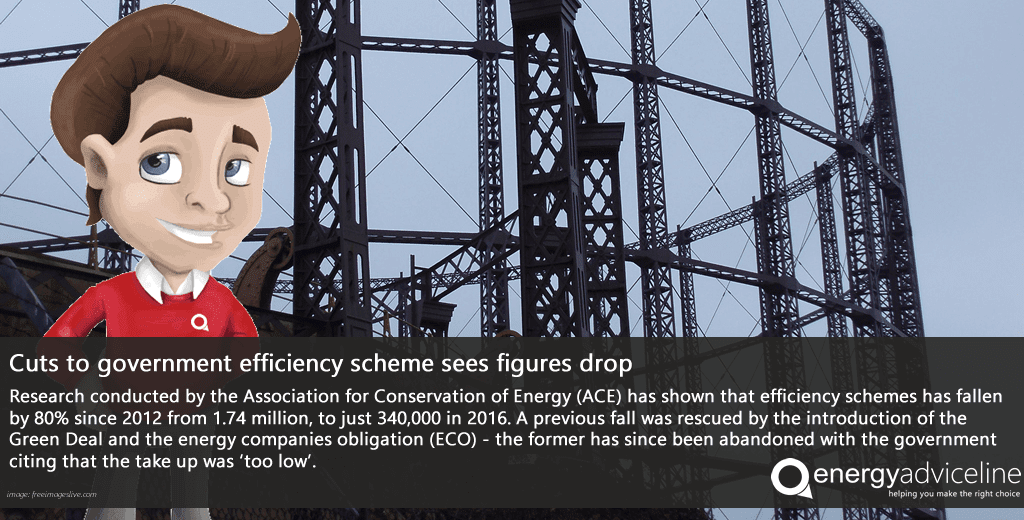
Cuts to government efficiency scheme
Programmes helping households to save on their heating bills have faced significant cut backs since 2012. These cuts have seen a drastic fall in the numbers of houses receiving help to warm their homes - statistics show that the figures have fallen by 75%.
Research conducted by the Association for Conservation of Energy (ACE) has shown that efficiency schemes has fallen by 80% since 2012 from 1.74 million, to just 340,000 in 2016. A previous fall was rescued by the introduction of the Green Deal and the energy companies obligation (ECO) - the former has since been abandoned with the government citing that the take up was 'too low'.
Julian Morgan, managing director of the switching service Energy Advice Line, said that this behaviour was unacceptable.
"More needs to be done to help homes, as it does businesses, to help people understand their energy bills, make sense of the tariff, and find out where cut backs can be made in order to start making some significant savings.
"What a lot of people don't realise is that while savings start by switching supplier, it's this colder time of year that bills peak and users need to be more conscious of where they should be making cut backs."
A spokeswoman for the DECC said: “This government is serious about making vulnerable people’s homes warmer and keeping energy bills low. That is why we are increasing support for those who need it most – the fuel-poor and vulnerable – whilst reducing the impact on people’s energy bills by cutting support for those able to pay.”
Meanwhile, the Energy Bill Revolution, an alliance of 200 organisations and businesses, said the blame for the “devastation” to the country’s home energy efficiency programme lay with Chancellor George Osborne.
If you want to find out more about how your energy bill works, and get independent, impartial advice on how to reduce your energy spend; contact energyadviceline.org.uk
Monday, 14 March 2016
Energy Advice Line calls for cap on back billing
Energy regulators should limit the amount of money energy suppliers can back-bill consumers when they charge them incorrectly, according to the Energy Advice Line.
Julian Morgan, managing director of the price comparison, switching and advice service for energy users, said householders and businesses should not have to suffer unexpected demands for money due to billing errors that were not their fault.
Last month it was revealed that millions of households had faced back bills averaging £206 after suppliers initially undercharged them in error. One in six people were told they were owed more than £250, while some people were hit with four-figure sums out of the blue.
Citizens Advice, which revealed the back billing problem, said 16,000 people had contacted the charity last year with bill concerns, and were worried about how they were going to pay.
"It's not fair that suppliers can back bill customers out of the blue for up to 12 months worth of gas or electricity, when they themselves were in error, due to a technical problem for example," Mr Morgan said.
"This places an unforseen burden on the budgets of households, as well as businesses, which I know suffer from this problem too.
"Customers should not have to pay the price for suppliers' mistakes. Consumers are already struggling with skyrocketing energy bills and this is the final straw for many who find it difficuly to make ends meet.
"Ofgem should drastically reduce and cap the amount of money suppliers can back bill customers.
"It should also ensure that consumers have a reasonable length of time to pay these belated bills.
"There is little incentive for suppliers to issue accurate bills when they can demand payment retrospectively. This is unfair and needs to change."
The Energy Advice Line is one of the UK's leading price comparison and switching services for business and domestic energy customers. It is also an advocate for energy market reform and has campaigned for a better deal for energy users, including calling for a ban on cold calling and changes to regulations to make it easier for all consumers to switch suppliers.
The service is completely independent and free. Consumers can quickly and simply search the market for the best available energy deals from an extensive panel of small and large energy suppliers. The service also offers a free advice line for business energy customers.
For further information visit energyadviceline.org.uk
Monday, 7 March 2016
E.ON launches energy audit service
The Energy Advice Line has cautiosly welcomed the launch of a new business energy audit service aimed at helping small and medium-sized firms reduce their energy use and carbon emissions.
The service, launched by energy giant E.ON, promises to identify measures firms can take to save energy - by upgrading equipment or changing working practices, for example.
"SMEs need all the help they can get to reduce their energy bills and larger companies may well benefit from this service," said Julian Morgan, managing director of Energy Advice Line.
Subscribe to:
Posts (Atom)